“I worry there are too many queer characters for readers to believe.” (Said a critique partner after reading the very first draft of Moon Dust In My Hairnet’s first act)
Upon hearing this feedback, I decided I needed more queer-coded characters, in fact.
MAYBE EVERYONE IS QUEER! Or, you know, “coded” that way…
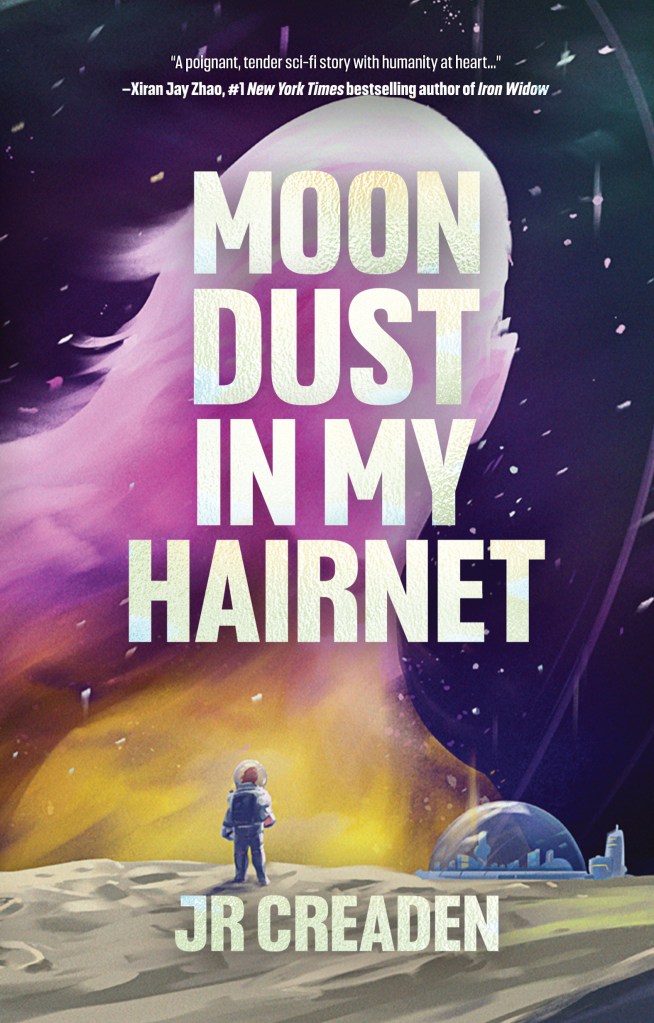
Art resembles life, and, at least in my experience, we queer and disabled folks tend to find each other and form new communities, bubbles of safety and support where we can be ourselves, loud and proud. But I want to talk about coding and assumptions, because there is so much that can be misconstrued between an author’s intentions and a reader’s experience.
While most readers appreciate the diverse rep in my book, several reviews have complained about my use of Black and black (the uppercase being an intentional mention of the cultural group of Black Americans, and the lowercase being a reference to skin color only), and then came to faulty conclusions that presumed (dis)ability, ethnicity, and identities of various characters. (I’m not saying these points are related, but I’m also not saying they aren’t.)
Assumptions can easily lead a reader to see whatever they want to see. I want to explore that phenomenon in regards to my debut and how it’s led some readers to misinterpret many of those identity markers, even those stated clearly.

I’ll start with sexuality, since that’s the most prevalent identity marker my main character Lane explicitly mentions. Off the page, I categorize Lane as bi/pan, demisexual, and polyamorous, with inklings of being transgender and nonbinary. On the page, however, this isn’t as clear or complete, because while Lane states flatly that she doesn’t understand monogamy, the rest of her labels are inference-only.
(Spoilers ahead in pink!! Don’t read in email browser unless you’re OK with spoilers!)
She narrates about liking girls but not having had a relationship with one; we see her in a relationship with Andrek. Their relationship is very loving and casual, and their friendship is as strong as their chemistry. =She’s bi/pan.
She’s distracted and often overwhelmed by her powerful attraction to Viveca, whom she imagines in romantic and sexual situations before admitting she has a crush. Once they kiss, Lane is able to turn more of her energy toward her goals without needing to accelerate their sexual connection beyond kissing. =She’s inexperienced with women, not just “horny.” Her expression of her sexual identity is often affected by her auDHD.
With Joule though, Lane recognizes his attractiveness and builds a strong friendship with him long before she realizes that she likes him “like that.” He is extremely forward about his interest in her from the beginning, so much so that she finds it unbelievable compared to his interest in Andrek. =She’s demisexual and experiences attraction uniquely with different genders and partners.
In fiction, relationships are esentially identities in action, but they still tend to be more complex than a mere label can portray. I’d argue that identity is doubly complex to show fully on the page, internal and personal as it is, and it’s impossible to assume correctly from a single point of view’s narrative.
The only seemingly straight-coded characters are Lane’s parents, the Tanners, and they’re only straight-coded in the sense that they’re a couple who are not specified as being non-cisgender or queer. For all readers know, both parents could be queer despite being in a heteronormative relationship.

Lane refers to her parents as monogamous at one point, but otherwise we know nothing about their sexual or gender identities. In my mind, Mrs Tanner is demisexual and bi/pan, leaning toward an attraction to women, and she just happened to marry Mr Tanner, a nonbinary person who uses he/him. Though, since it’s not their story and Lane doesn’t tell us, one can assume anything about their identities so long as it includes the two of them together. If one were to look at me and my spouse, they might draw the same simple cishet conclusions, but well…
They’d be wrong.
See what I mean about assumptions? There’s no reason for every character’s sexual identity to be stated, and Lane, whose perspective we’re in for the whole book, only cares to mention those closest to her within her growing polycule and only when that identity is notable to her.

Take Halle Fromme, for example. Halle is stated to be a Black transwoman who’s ace (asexual) and monogamous with her girlfriend Viveca. She is still a part of Lane’s polyamorous polycule via Viveca’s involvement with Lane and Joule. Readers also know she’s autistic, because she says so, that she’s from the southeast US because of her accent, and we also know she’s chubbier than Lane “in all the best ways.” Absolutely nothing else is known about her gender or sexual identity journey, not just because she doesn’t share more than that, but because it isn’t relevant to her character’s actions in the story. (Go read books by Black trans authors to get those stories!)
When Lane realizes Halle is transgender, she mentally adds “like Chef and Zhara,” and the mention is a casual offhand because that’s how Lane thinks of it, as just another trait to notice when meeting new people. This wasn’t me sneaking in more trans characters for diversity points; it was a way of demonstrating how little that fact matters to Lane’s perception of Halle (because she’s far more interested in Halle’s blue hair and video game).
We don’t need to know how well (or not) these characters pass, nor should we assume all other characters are cisgender simply because Lane doesn’t classify them as trans for us. “Passing” is a privilege that’s not possible for all transfolks, and I didn’t see the need to spell that out for readers.
I admit I deliberately chose not to explore gender identity within Lane’s character (who, to me at least, is obviously nonbinary but hasn’t processed it yet), because I wasn’t ready to put that personal journey on display. If readers assume she’s cis simply because she’s AFAB and uses she/her, so be it, but don’t hoist that assumption onto me as the author neglecting to diversify. Not every queer person is out in all ways from go, just like not all transgender people choose to change their pronouns, and nonbinary folks don’t owe anyone androgyny.

Likewise with disabilities! As an autistic ADHD character, Lane is excited to realize when others around her, especially her crush, are neurodivergent, but not all disabilities are so easily recognized, even by her. Since her boyfriend has a physical disability and wears a prosthetic, she is more likely to notice others wearing prosthetics, like those in the Meat Team. Wheelchair users and Little People (like Commander Han and Cheese) are quite noticeable, in their use of mobility aids or not, so Lane calls attention to these because they capture her attention. That doesn’t rule out there being other disabled people in the trust around her, unnoticed. As with most main characters in any sci-fi setting, she’s got A LOT on her mind to distract her.
Also with multinationalism and mixed races– Lane mentions what she happens to notice, with white and black characters being the most prominent because they’re the easiest for her to recognize. Her crush Viveca is of mixed races, but Lane doesn’t obsess over “what else” Viveca is besides wondering what her dad looks like, because in the world they live in, whole populations have been forced to migrate, making that conversation even more sensitive an issue than it is for our world. Lane especially would rather avoid causing that kind of harm, and when she stumbles into such situations accidentally, she feels terrible and struggles to recover.
Lane is white. Why? Because I’m white, and she’s my main character, and I choose to write “in my Lane.”
I’m going to err against custom and respond directly to some critiques of this book’s stance on whiteness being a factor in this future setting.
Yes, this is the future, but it’s only twenty years ahead of us in 2024. The privileges of whiteness aren’t likely to disappear within the next two decades, and they certainly won’t if we refuse, in the here and now, to acknowledge the myriad of ways whiteness, colorism, and antiblackness impact our daily lives the world over.
The setting of my book is that of an intentional community seeking to do better, differently, on the moon, but they are only a small percentage of a humanity whose core issues remain. The Earth that the trustees left behind is still our world, albeit with twenty more years of suffering and upheaval from climate change. I allowed for polyamory, queerness, antiracism, and disabilities to be more normalized within this small group on the moon out of sheer personal wish fulfillment, but it felt wrong to pretend racism on Earth would be so easily solved.
I tried to make these points clear throughout the story, particularly in the ways that food and peoples had shifted beyond current borders, but I also tried to remain sensitive to the very real fears of identity loss that coincides with such blending ethnicities. The goal Faraday (and I, let’s be real) set for the lunar community was inclusivity, accessibility, and diversity in the creation of a “new lunar culture,” not erasure of home origins or cultures– a potluck rather than a melting pot. I’m only an author, not a psychic, but I expect if humans survive to settle space, we’ll need the full wealth and span of human diversity informing us as we adapt to challenges beyond our home planet.
Could I have done better to achieve these goals? If you know a way, I’d love to learn how, because I aim for all my books to be at least this diverse and inclusive, never less. I’ll keep doing my very best in the meantime.
I’m open to questions here as long as comments remain civil, so ask if you’ve got one!

***
The audiobook of Moon Dust In My Hairnet is available for the next few weeks on Netgalley, so hop over there if you’re interested (click picture below)
Print and ebook copies are available to order here on Bookshop, or ask for it at your local bookstore. If they choose to stock it, let me know and I’ll send them a special gift for new readers!
If you prefer to use the library, the information needed to request it is here for all formats.
If you’re ready to leave a review on Goodreads or Amazon, it would help me a lot!
If you’d like to privately post a review, request an interview, or feature my book on your site, please let me know! I can’t say yes to everything, but I promise to try, and I’ll boost your efforts regardless. 💖
***


 JR Creaden
Leave a comment